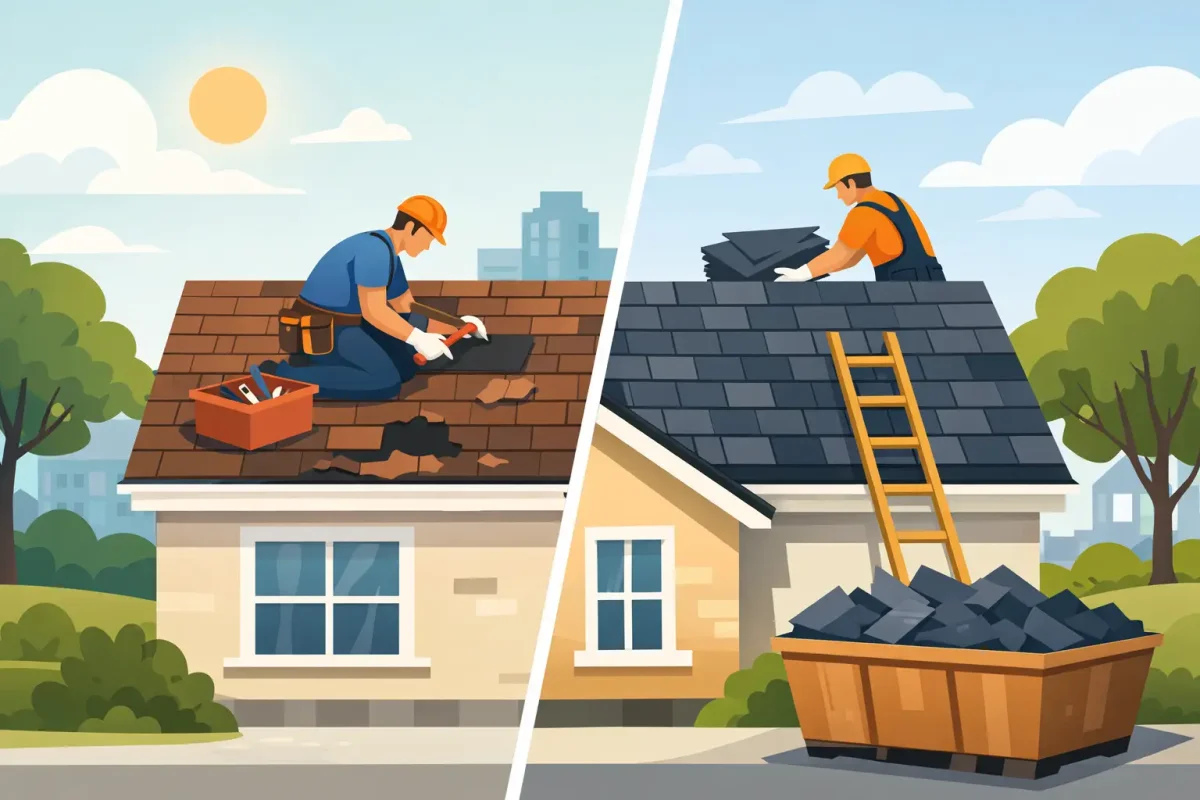
A roof leak rarely shows up at a convenient time. It starts as a ceiling stain, a few missing shingles after a storm, or granules collecting in the gutter. Then the real question hits: roof repair vs replacement – which one actually makes sense for your home, your budget, and the condition of the roof you already have?
For most homeowners, the answer is not as simple as patch the problem and move on. A repair can be the right call when damage is limited and the rest of the roof still has solid years left. But if the system is aging, moisture has spread farther than you can see, or multiple exterior components are starting to fail at once, replacement often saves money and stress over the long run.
Roof repair vs replacement starts with the age of the roof
Age is one of the clearest indicators because roofing materials have a predictable lifespan. Asphalt shingles, which are common on homes across Southern Ontario and many U.S. markets, generally last around 15 to 30 years depending on product quality, ventilation, installation, and weather exposure. A newer roof with one isolated issue is usually a repair candidate. A roof nearing the end of its expected life is a different story.
If your roof is 5 to 10 years old and a few shingles blew off in a windstorm, repair is often the practical choice. If it is 22 years old and now leaking around valleys, flashing, and vents, replacing one section may only delay a larger and more expensive problem.
This matters even more when homeowners have already paid for several repairs over the past few years. One patch may be reasonable. Repeated patchwork on an aging roof often turns into spending good money on a system that is already wearing out.
When roof repair is the better option
A focused repair makes sense when the issue is limited, the roof structure is still sound, and the remaining shingles are in decent condition. In these cases, the goal is to correct the weak point before water spreads into the decking, insulation, soffit, fascia, or interior finishes.
Common situations where repair may be enough include minor storm damage, a small area of missing shingles, lifted flashing around a chimney or wall, a leak around a roof vent, or localized damage from a fallen branch. These are usually targeted problems with a clear source.
A repair is also more attractive when the shingles can still be matched reasonably well. On a newer roof, that is more likely. On an older roof, color fade and discontinued products can make a repair look obvious, which is not a structural issue by itself but can affect curb appeal.
The biggest advantage of repair is cost. If the roof still has useful life left, a professional repair can stop the leak, protect the home, and avoid replacing a system too early. For homeowners preparing to sell in the near future, a repair may also be the most sensible short-term investment if the roof is otherwise serviceable.
When replacement is the smarter investment
Replacement becomes the better option when the problem is no longer isolated. If water is getting into multiple areas, shingles are curling or balding across large sections, or the roof deck has started to soften, the issue is bigger than one leak point.
Widespread wear usually means the roof is failing as a system, not just at one detail. That system includes underlayment, flashing, ventilation, drip edge, and the shingles themselves. Once several parts start breaking down together, repairs become less reliable.
A full replacement is often the right call if you are dealing with recurring leaks, significant storm damage, visible sagging, mold concerns in the attic, or repair costs that keep stacking up. It also gives you the chance to correct underlying issues like poor ventilation or improper flashing details that may have shortened the roof’s life in the first place.
There is also the resale factor. Buyers notice an old roof fast, and home inspectors do too. A new roof can improve buyer confidence, reduce negotiation headaches, and help protect the value of other exterior improvements.
Cost is important, but short-term cost is not the whole story
Many homeowners compare the price of a repair to the price of a full replacement and stop there. That is understandable, but it can be misleading.
A repair almost always costs less upfront. The better question is what that repair buys you. If it gives you another 8 to 10 years from the roof, that is money well spent. If it buys you six months before another leak appears on a different slope, it is not really a savings.
Replacement costs more because it addresses the full system, removes hidden damaged materials, and gives you a fresh warranty. It can also reduce the risk of secondary costs like drywall repair, insulation replacement, mold remediation, and damaged fascia boards caused by ongoing moisture intrusion.
For homeowners planning broader exterior work, timing matters too. If the roof is near the end of its life and you are already considering new siding, gutters, soffit, or fascia, coordinating those projects can make more sense than fixing one failing component at a time. A complete exterior approach often protects the home better and avoids reworking adjacent materials later.
Signs you should not ignore
Some roofing problems look minor from the ground but point to larger trouble underneath. Water stains on ceilings, dark streaks in the attic, peeling paint near rooflines, shingle granules in gutters, and soft spots underfoot on the roof surface all deserve a closer look.
You should also pay attention to anything happening around the roof edge. Damaged eavestroughs, rotted fascia, and poor drainage can contribute to roof deterioration by allowing water to back up where it should be directed away. Homeowners often think they have a roofing issue alone when the problem actually involves several connected exterior components.
That is why a proper inspection matters. The visible symptom is not always the source. A leak near a window or wall may begin much higher up at flashing, underlayment, or a roof penetration.
How a contractor should help you decide
A trustworthy contractor should not push replacement on every home, and they should not offer a quick repair without checking the full condition of the roof. You want a clear assessment of what is damaged, how widespread it is, how much life the roof likely has left, and whether related components are also affected.
That assessment should include more than shingles. Flashing, ventilation, decking, gutters, soffit, fascia, and attic conditions all matter because they affect how the roof performs over time. If the contractor only talks about the visible leak area, you may not be getting the full picture.
This is where working with an exterior contractor can make a real difference. Companies like Petra Eavestrough & Siding look at the home as a system, which helps homeowners avoid fixing one issue while another connected problem keeps developing nearby.
The best choice depends on timing, condition, and your plans for the home
There is no one-size-fits-all answer to roof repair vs replacement. A newer roof with localized damage usually deserves a quality repair. An older roof with repeated leaks, widespread wear, or hidden moisture damage is often better replaced before the next problem shows up.
Your plans matter too. If you want the lowest immediate expense and the roof is otherwise healthy, repair may be the right move. If you want predictable performance, stronger protection, better curb appeal, and fewer surprises over the next decade, replacement may be the better value.
The key is not guessing from the driveway. A professional inspection gives you the facts, the trade-offs, and a recommendation based on the actual condition of your home. That makes it easier to spend money once, spend it wisely, and move forward with confidence.

9 July 2026
How to Prevent Gutter Overflow at Home

9 July 2026