
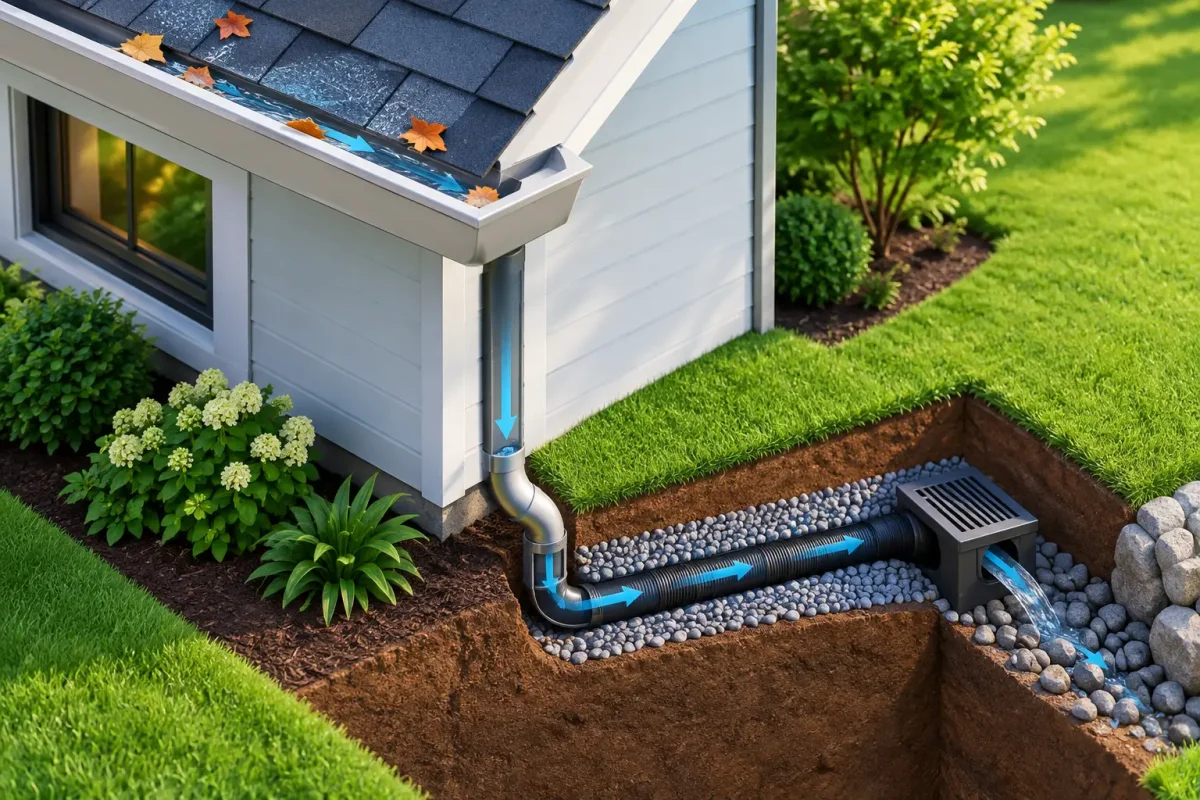
A wet strip of soil beside the foundation is rarely just a landscaping problem. When roof runoff lands too close to the house, it can soak basement walls, stain siding, erode garden beds, and create icy walkways when temperatures drop. This case study of gutter drainage solutions shows how a practical, whole-system approach can move water where it belongs: away from the home.
The scenario is based on a common residential drainage issue: a detached home with aging gutters, short downspout extensions, and visible pooling near two foundation corners. The gutters were not completely failing, but they were undersized in key areas and pitched poorly after years of seasonal movement. The result was predictable – during heavy rain, water spilled over the front edge and discharged beside the house.
The Problem: Water Was Reaching the Foundation
The homeowner first noticed the issue after a series of heavy storms. Water was overflowing near a roof valley, the mulch along one wall kept washing away, and a damp smell appeared in a finished basement storage room. There was no single dramatic failure. Instead, several smaller issues were working together.
The roof had a large rear section that fed into one gutter run. That run had only one downspout, located near the middle rather than near the lowest practical collection point. Debris also collected at the outlet, slowing water during peak rainfall. At ground level, the downspout ended less than two feet from the foundation, where the grade was nearly flat.
This is an important distinction for homeowners. A gutter can look acceptable from the driveway and still fail under real rain conditions. Drainage problems often show up only when a fast-moving volume of water reaches the system all at once.
Case Study Gutter Drainage Solutions: The Inspection
A proper drainage plan begins at the roofline, not at the basement wall. The inspection focused on the entire water path: roof surface, valleys, gutter capacity, gutter slope, downspout placement, discharge location, and ground grading.
The first finding was capacity. The existing gutter profile was too small for the roof area feeding the rear run, particularly where two roof planes met at a valley. Water was being delivered faster than the gutter could carry it during strong storms. Installing a larger gutter with a larger outlet would give the system more room to manage peak flow.
The second finding was pitch. Gutters need a controlled slope toward their downspouts. Too little slope allows standing water and debris buildup. Too much can look uneven from the street and may cause water to move too quickly past an outlet. The goal is a clean, consistent line that drains efficiently without hurting curb appeal.
The third issue was discharge. Even a well-installed gutter system cannot protect a foundation if the water is released beside it. The downspout extensions needed to carry runoff farther from the house, toward areas where the landscape could safely absorb or direct it.
The Recommended Drainage Plan
The solution was not simply to replace a few leaking sections. The homeowner needed a coordinated system sized for the roof and the property layout.
The rear gutter run was replaced with a larger, continuous aluminum gutter. Seamless gutters reduce the number of joints where leaks can develop, which is especially helpful on long runs exposed to repeated freeze-thaw cycles. The new system was fastened securely and pitched toward properly sized outlets.
A second downspout was added near the end of the run. Splitting the water load between two outlets reduced the chance of overflow when the valley sent a surge of rainwater into the gutter. The existing front-side downspout was also adjusted so that it drained clear of the walkway rather than creating a slippery area during colder weather.
At ground level, the drainage plan used extended discharge points placed away from the foundation. Depending on the yard, this can mean above-ground extensions, buried solid pipe, or a combination of both. In this case, a buried drain line made sense along the rear wall because the homeowner wanted to preserve the appearance of the garden and direct water toward a lower portion of the property.
The grading around the foundation was also corrected in the worst pooling area. Gutters move water off the roof, but the soil still needs to slope away from the home. Without that final step, discharged water can travel back toward the foundation after every storm.
Why Bigger Gutters Alone Would Not Have Solved It
Homeowners often ask whether larger gutters are the answer. Sometimes they are, but capacity is only one part of the equation.
A larger gutter will not fix a blocked outlet, a missing downspout, poor grading, or an extension that ends beside the foundation. In the same way, underground drainage is not automatically the best option if the pipe has nowhere appropriate to discharge. A responsible plan considers the lot layout, local drainage conditions, visible landscaping, and the amount of roof runoff being managed.
Leaf protection can also help reduce maintenance, but it is not a substitute for correct sizing and drainage design. If a system overflows because a valley delivers too much water to one section, adding gutter guards without addressing capacity may leave the core problem in place.
Installation Details That Made the Difference
The installation focused on the details that tend to affect long-term performance. The new gutters were aligned carefully with the fascia for a straight appearance. Hangers were spaced to support the gutter through snow, ice, and seasonal temperature changes. Downspout outlets were sealed and secured, and elbows were positioned to keep water moving without unnecessary turns.
This was also a good opportunity to inspect the fascia and soffit behind the old gutter. Overflowing water can damage the boards that support the gutter system, especially when it has been happening for several seasons. Replacing damaged material before installing new gutters gives the new system a solid base and avoids covering up a problem that will continue to worsen.
For homes with aging siding, roofing concerns, or deteriorated fascia, coordinating these repairs during the same exterior project can save time and reduce disruption. Petra Eavestrough & Siding approaches gutter work as part of the home’s full exterior protection system, not as an isolated piece of metal along the roofline.
The Result: A Clearer Path for Rainwater
After the work was completed, rainwater had a direct route from roof to gutter, from gutter to downspout, and from downspout away from the foundation. The rear garden bed stopped washing out, the pooling area beside the home dried more quickly, and the homeowner no longer saw water spilling over the gutter during heavy rain.
Just as important, the system looked cleaner. Straight gutter lines, matched downspouts, and concealed drainage where appropriate improved the home’s exterior without drawing attention to the drainage work itself. Good drainage should be noticeable in its results, not in how much it dominates the appearance of a house.
When to Schedule a Gutter Drainage Inspection
Do not wait for a basement leak to take water management seriously. An inspection is worthwhile if you see overflow during rain, peeling paint near the roofline, water marks on siding, washed-out mulch, soil erosion, or downspouts that empty beside the foundation. Persistent ice buildup near entrances is another warning sign.
The right fix depends on your roof shape, gutter condition, lot grading, and where water can safely go after it leaves the downspout. A professional on-site assessment can identify whether you need a targeted repair, a gutter replacement, added downspouts, drainage extensions, or a more complete exterior update.
A dry foundation starts with a simple principle: every gallon of roof runoff needs a planned path away from your home. Addressing that path before the next major storm can protect your exterior, your landscaping, and the space inside your walls.

9 November 2026
How Oakville Window Installers Protect Your Home

9 November 2026