
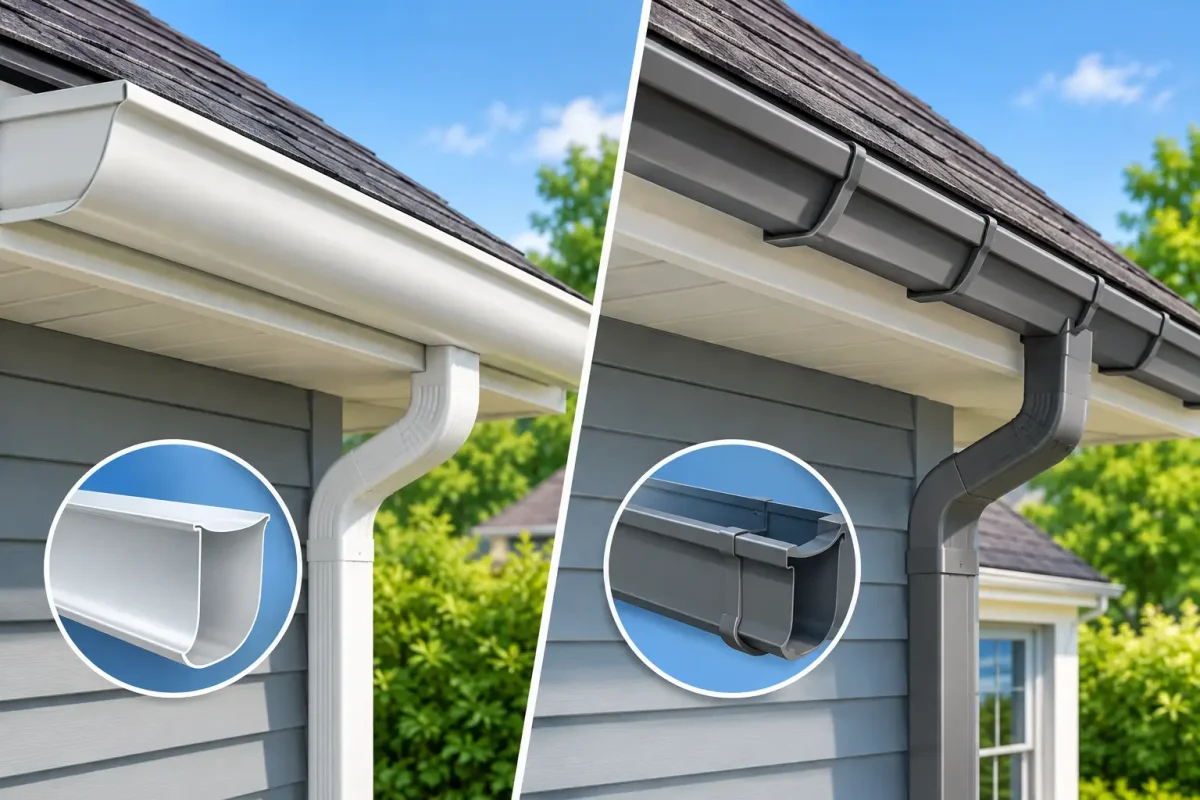
A gutter system can look fine from the driveway while quietly sending water behind fascia boards, toward the foundation, or across walkways. When comparing seamless versus sectional gutters, the real question is not which option is universally best. It is which system will manage water reliably on your home, fit your budget, and hold up through years of rain, snow, ice, and debris.
For most homeowners replacing an aging system, custom-formed gutters are the stronger long-term choice. Sectional gutters still have a place, particularly for small repairs, short runs, or tighter budgets. The right recommendation depends on the roof layout, drainage needs, material, and condition of the surrounding soffit, fascia, and roof edge.
What Is the Difference Between Seamless and Sectional Gutters?
Sectional gutters are sold in pre-cut lengths and joined together during installation. A typical system may have multiple pieces along one side of a house, connected with seams, connectors, end caps, corners, and sealant. They are commonly available in vinyl, aluminum, steel, and other materials.
Custom-formed gutters are made on site from a continuous coil of metal. An installer measures each roofline and uses a gutter-forming machine to create one long piece for that run. There are still joints at corners, downspouts, and end caps, but there are far fewer connections along the straight sections of the home.
That distinction matters because joints are the most likely areas for a gutter system to leak, collect debris, or separate over time.
Seamless Versus Sectional Gutters: The Main Trade-Offs
A sectional system usually costs less up front. Materials are readily available, and a short damaged piece can sometimes be replaced without rebuilding an entire run. For a detached garage, shed, or a limited repair where matching an existing system matters, that can be a practical solution.
Custom-formed aluminum gutters generally cost more initially because they require professional measurement, specialized equipment, and installation. In return, homeowners get fewer seams, a cleaner appearance, and fewer potential leak points. On a full eavestrough replacement, the higher initial cost often makes sense because the system is built for the home rather than assembled from standard lengths.
Neither option eliminates maintenance. Leaves, roof grit, ice, and standing water can cause trouble in any gutter if the slope is wrong, the downspouts are undersized, or the system is allowed to clog. Good installation matters as much as the gutter style itself.
Leak Risk and Water Protection
Every sectional connection depends on a seal. Sealant can dry out, crack, or lose adhesion as the material expands and contracts with temperature changes. Water may drip from a failed seam long before the problem becomes obvious from the ground.
With custom-formed gutters, straight runs have no mid-run joints to reseal. This reduces, but does not remove, the chance of leaks. Corners, end caps, outlets, and downspout connections still need careful sealing and fastening. A properly pitched system also keeps water moving instead of allowing it to pool near a joint.
For homes with long rooflines, heavy runoff, or recurring water issues around the foundation, reducing the number of seams is a meaningful advantage.
Appearance and Curb Appeal
Long, continuous gutter runs look cleaner. They follow the fascia line without visible connectors every few feet, which is especially valuable when new gutters are part of a larger exterior update involving siding, soffit, fascia, or roofing.
Sectional gutters can still look neat when installed well. However, their joints are more noticeable, and slight movement over time can make the system look uneven. Vinyl options can also fade, become brittle in cold weather, or sag if they are not properly supported.
Aluminum is a common choice for residential gutters because it is lightweight, corrosion-resistant, and available in colors that coordinate with trim and siding. The best color is usually one that complements the fascia rather than calling attention to the gutters themselves.
Repairs and Future Changes
Sectional gutters have one clear benefit: localized damage may be easier to address. If a branch dents a single short section, a contractor may be able to replace that piece instead of replacing the full run.
A custom-formed gutter can also be repaired, but a severely damaged long section may need to be replaced from corner to corner. That is not necessarily a drawback when the rest of the system is aging, but it can affect the cost of a small isolated repair.
If you expect to add a deck roof, sunroom, or other structure soon, tell your contractor before replacing gutters. Planning the drainage layout now can prevent avoidable rework later.
Cost: Look Beyond the Price Per Foot
It is tempting to compare gutter quotes only by the price per linear foot. That misses the parts of the project that determine whether water is actually controlled.
A useful estimate should account for the gutter material and size, the number of downspouts, corners, outlet locations, hangers, removal of old gutters, and any fascia repair needed before installation. It should also consider access challenges, roof height, and drainage extensions that move water away from the foundation.
A lower quote may use lighter material, fewer hangers, undersized downspouts, or minimal preparation. Those shortcuts can lead to sagging, overflowing, and premature repairs. A well-installed system should be securely fastened, properly pitched, and sized for the roof area it serves.
For many homes, a 5-inch gutter works well. Larger roof planes, steep roof pitches, or areas that receive intense rainfall may benefit from 6-inch gutters and larger downspouts. This is a drainage decision, not just an appearance upgrade.
When Sectional Gutters Make Sense
Sectional gutters are not automatically the wrong choice. They can be a reasonable fit when the project is small, temporary, or budget-driven. They may work well on a shed, a simple detached structure, or a short run where a homeowner needs a straightforward replacement.
They can also be useful when repairing an existing sectional system that is otherwise in good condition. Replacing one damaged component may be more sensible than removing functional gutters from the entire house.
The key is to be realistic about maintenance. Joints need periodic inspection, especially after freeze-thaw cycles and seasons with heavy debris. If seams repeatedly leak or sections pull apart, patching may be delaying a system-wide replacement.
When Custom-Formed Gutters Are Worth It
For a full replacement on a primary residence, custom-formed aluminum gutters are often the better investment. They are particularly well suited to homes with long straight rooflines, finished landscaping near the foundation, or visible fascia where a cleaner result matters.
They are also a strong option when old gutters have caused staining, rot, overflow, or water near the basement walls. Replacing the gutter without checking the fascia, drip edge, roof condition, and downspout discharge can leave the underlying problem unresolved.
Homeowners in Hamilton, Burlington, and Oakville also need systems that can handle changing weather. Snow and ice do not make gutter leaks inevitable, but they put extra stress on poorly supported runs and weak joints. Proper hangers, sound fascia, and a clear drainage path are essential.
Installation Details That Matter More Than the Gutter Type
The best gutter material cannot compensate for poor workmanship. During an inspection, a qualified exterior contractor should look at the roof edge, fascia condition, existing water marks, grading near the home, and the location of doors, walkways, and landscaping.
The gutters should have a controlled slope toward downspouts, without an obvious tilt that looks sloppy from the ground. Hangers should be spaced closely enough to support the system through wind, snow, and water weight. Downspouts should carry water away from the foundation, not release it directly beside the house.
Ask how old materials will be removed, whether damaged fascia will be identified before installation, and what warranty applies to both materials and labor. Clear answers protect you from surprises once work begins.
A gutter replacement is a chance to stop chasing drips and protect the parts of your home that water reaches first. Choose the system that supports reliable drainage now, then make sure the installation plan gives that water a safe place to go.
17 November 2026
Can Gutters Damage Foundation? Yes. Here’s How

17 November 2026