
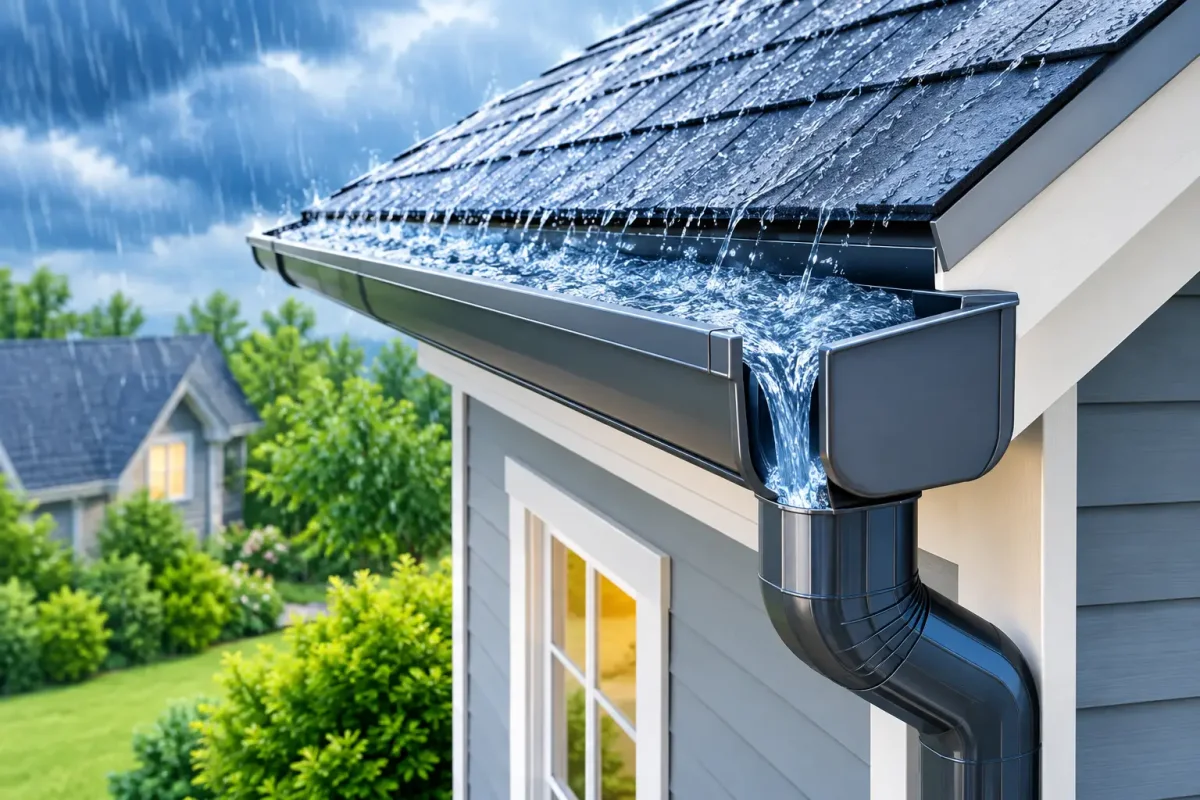
A hard downpour should run off your roof, through your gutters, and safely away from the house. If water spills over the edge, pounds the soil beside the foundation, or leaks behind the fascia, the system is undersized, poorly pitched, clogged, or all three. The best gutters for heavy rain are not simply the biggest gutters available. They are the right size, material, downspout layout, and installation quality for your roof and property.
For homeowners, this is about more than avoiding an annoying waterfall at the front door. Uncontrolled roof runoff can stain siding, rot fascia boards, damage landscaping, wear away soil, and contribute to basement moisture problems. A professionally designed gutter system gives that water a controlled route from roof to ground.
What Makes Gutters Work in Heavy Rain?
Gutter performance starts with capacity. A roof collects far more water than most people expect during a fast-moving storm. The larger and steeper the roof, the more water reaches the eaves at once. Long roof valleys also concentrate runoff into one small section of gutter, creating a common overflow point.
The gutter must be large enough to carry that volume, but size alone will not solve every problem. It also needs proper slope toward the downspouts, securely fastened hangers, correctly sized outlets, and a discharge point that moves water well away from the foundation. A quality installation accounts for the full water path, not just the horizontal trough under the roofline.
Best Gutters for Heavy Rain: The Right Size First
For many homes, 5-inch K-style gutters are a standard starting point. They can work well on modest roof areas with straightforward rooflines and properly spaced downspouts. However, homes with broad roof planes, steep pitches, multiple valleys, or a history of overflow often benefit from a larger system.
Why 6-inch gutters are often the better choice
Six-inch seamless K-style gutters provide noticeably more capacity than 5-inch gutters. That added room helps water move through the system during intense rainfall instead of spilling over the front edge. They are a practical upgrade for larger detached homes and properties where heavy storms are a regular concern.
A 6-inch gutter also accommodates larger outlets and downspouts. This matters because a wide gutter feeding into a narrow downspout can still back up in a storm. When capacity is the priority, the gutter and downspout should be designed as one system.
Consider larger downspouts, too
Downspouts are where roof water exits the gutter system. Standard 2-by-3-inch downspouts may be sufficient for smaller drainage areas, but 3-by-4-inch downspouts carry significantly more water. They are especially useful below valleys, at the end of long gutter runs, and on homes with large roof sections draining to one point.
Adding a downspout can be just as effective as increasing its size. The right choice depends on the roof layout, the available wall space, and where water can be directed on the property. More downspouts are not automatically better if they dump water next to the foundation. Each one needs a clear, controlled discharge route.
Seamless Aluminum Is the Best All-Around Material
For most homeowners, seamless aluminum is the best material choice for heavy rain. It is lightweight, corrosion-resistant, available in many colors, and formed on-site to match the length of each gutter run. Fewer seams mean fewer common leak points.
Aluminum also offers a strong balance of durability and value. It will not rust like unprotected steel, and it is generally more practical for a full residential installation than copper. With professional installation and routine maintenance, a quality aluminum gutter system can provide years of reliable performance.
Steel can be strong, but it requires dependable protective coatings to resist corrosion. Copper is long-lasting and visually distinctive, but its price puts it outside the needs of most homeowners. Vinyl is inexpensive, yet it can become brittle in changing temperatures, sag under load, and expand or contract more than metal. For high-volume rain management, seamless aluminum is usually the dependable choice.
K-Style vs. Half-Round Gutters
K-style gutters are the most common choice for modern residential homes, and for good reason. Their profile holds more water than a similarly sized half-round gutter, and the flat back mounts securely against the fascia. They also suit many home styles and are available in colors that coordinate with siding, soffit, and trim.
Half-round gutters can look excellent on historic or traditional homes, but they usually need more size to match the capacity of a K-style system. If appearance is the main goal, half-round may be worth considering. If the property regularly sees hard rainfall and the roof has complex drainage areas, a 6-inch K-style system is often the more practical recommendation.
Installation Details That Prevent Overflow
Even the best material and size will disappoint if the system is installed without attention to drainage. Gutters need a slight, consistent pitch toward each downspout. Too little slope allows standing water and debris buildup. Too much slope can look uneven and may cause water to rush past the outlet rather than drain efficiently.
The system also needs strong hangers installed at appropriate intervals. Gutters become heavy when filled with rainwater, wet leaves, or ice. Loose hangers allow the gutter to sag, which creates low spots where water sits and eventually spills over.
The roof edge matters as well. Water should enter the gutter rather than run behind it. Proper flashing and drip edge help direct runoff into the trough while protecting the fascia board. If fascia is soft, stained, or rotted, replacing gutters without addressing that damage only hides the problem for a while.
A reliable installation should also account for valleys. These high-volume areas may need a wider gutter, a larger downspout, or a layout change to keep up during a cloudburst. This is why an on-site inspection is more useful than selecting gutter sizes based on a single online rule of thumb.
Do Gutter Guards Help During Heavy Rain?
Gutter guards can help, but they are not a substitute for proper gutter capacity. Their main job is to reduce leaves, needles, and debris entering the gutter. A clean gutter drains better than a clogged one, especially when rain is coming down fast.
The trade-off is that some guard designs can slow water entry during extremely heavy rainfall or collect fine debris on top. The right guard depends on the tree cover around the home, roof pitch, and the type of debris falling onto the roof. A quality product installed correctly can reduce maintenance, but homeowners should still expect occasional inspection and cleaning.
Move Water Away From the Foundation
A gutter system is only as effective as its discharge. Downspouts should direct water away from the home through properly placed extensions or a suitable drainage solution. Letting water empty at the base of the wall defeats much of the purpose of larger gutters.
Watch for signs that runoff is not moving far enough: eroded mulch, puddles beside the house, damp basement walls, cracked walkways, or soil that stays saturated after a storm. These concerns may require more than a longer splash block. Grading, drainage routes, and landscaping should work with the gutter system, not against it.
When It Is Time to Replace Your Gutters
Frequent overflows are a clear warning, but they are not the only one. Sagging sections, peeling paint, visible seams pulling apart, recurring leaks, rust, loose downspouts, and water marks on the fascia all point to a system that needs attention. Repeated repairs on an aging, undersized gutter system can cost more over time than a properly designed replacement.
For homes in Hamilton, Burlington, and Oakville, a professional inspection can identify whether the issue is capacity, slope, roof drainage, fascia damage, or a combination of factors. Petra Eavestrough & Siding can assess the complete exterior water-management picture and recommend a clean, durable solution built for the home rather than a one-size-fits-all fix.
The right gutter system should disappear into the background after the work is done. When the next heavy storm arrives, water should move where it belongs, your foundation should stay protected, and you should not have to stand at the window wondering what is overflowing.

15 November 2026
Fascia Repair That Stops Roofline Damage Early
15 November 2026